
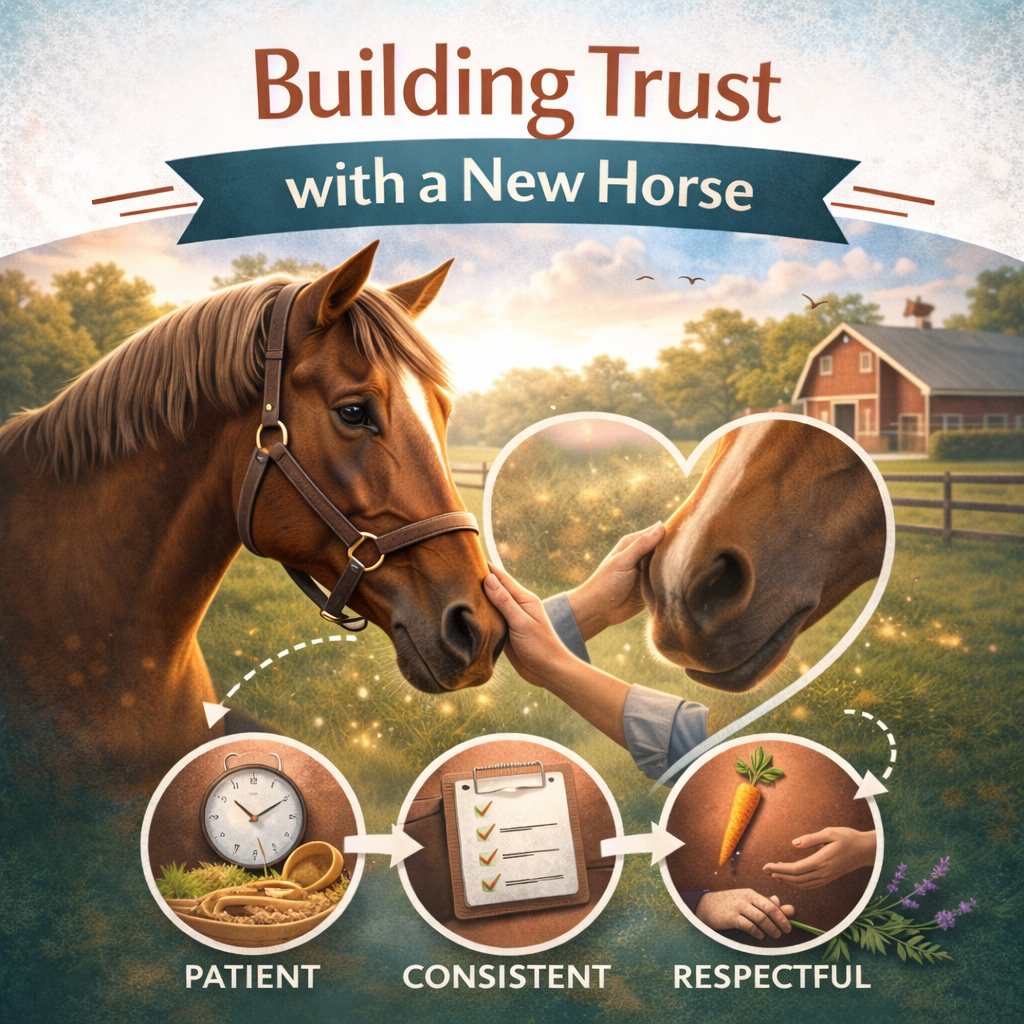
Bringing a new horse into your care is both exciting and delicate. Trust is not automatic — it is built through consistency, clarity and calm leadership. Horses assess safety through body language, predictability and pressure-release communication.
Trust is not dominance.
It is reliability.
This guide explains how to build a secure foundation with a new horse, whether newly purchased, loaned or recently relocated.
Understanding the Horse’s Perspective
Horses are prey animals.
When entering a new environment, they assess:
- Safety of surroundings
- Predictability of humans
- Social hierarchy
- Handling consistency
- Personal space boundaries
They do not immediately “trust” unfamiliar handlers.
They look for consistency.
1. Give Time to Decompress
The first days after relocation are critical.
Allow:
- Quiet turnout
- Minimal pressure
- Observation from distance
- Consistent feeding schedule
Avoid:
- Immediate intense riding
- Multiple handlers
- Frequent changes
Stress levels are often elevated after travel or relocation.
Time stabilises the nervous system.
2. Establish Predictable Routine
Routine builds security.
Keep:
- Feeding times consistent
- Turnout regular
- Handling sequence predictable
Approach from the same side and use a consistent tone of voice.
Consistency reduces uncertainty.
3. Respect Personal Space
Trust grows from clear boundaries.
When handling:
- Do not crowd
- Stand at the shoulder
- Maintain calm posture
- Avoid sudden movements
If the horse steps into your space, correct calmly.
Leadership without aggression builds respect.
4. Use Pressure and Release Correctly
Horses learn through pressure and release.
Apply:
- Light pressure
- Clear cue
- Immediate release upon response
Never:
- Hold pressure endlessly
- Escalate unpredictably
- Mix signals
Clarity builds confidence.
Confusion creates anxiety.
5. Prioritise Groundwork First
Before intensive ridden work, focus on:
- Leading politely
- Halting promptly
- Backing softly
- Yielding to light pressure
- Standing calmly
Groundwork establishes a shared communication language.
Trust on the ground transfers to ridden work.
6. Keep Sessions Short and Positive
Early sessions should be:
- Brief
- Calm
- Focused
- Successful
End on a positive response.
Overworking a new horse damages early trust.
Confidence builds gradually.
7. Avoid Emotional Reactions
Frustration erodes trust.
If mistakes occur:
- Pause
- Reset
- Maintain neutral tone
Horses respond strongly to human energy.
Your emotional regulation influences their behaviour.
8. Recognise Stress Signals
Watch for:
- Tight jaw
- Swishing tail
- Elevated head carriage
- Wide eyes
- Increased respiration
- Avoidance behaviour
Trust grows when stress signals are acknowledged — not ignored.
Adjust your approach accordingly.
9. Build Positive Associations
Associate your presence with:
- Calm grooming
- Scratches in preferred spots
- Relaxed hand-grazing
- Quiet stable time
Positive reinforcement strengthens the bond.
Small moments matter.
10. Maintain Fairness and Consistency
Trust collapses when responses are inconsistent.
Do not:
- Punish unpredictably
- Allow behaviour one day and correct the next
- Change rules frequently
Fairness builds reliability.
Reliability builds trust.
11. Introduce Challenges Gradually
Once the foundation is secure:
- Introduce new environments slowly
- Increase workload progressively
- Avoid overwhelming situations early
Exposure should be structured.
Confidence develops step by step.
12. Understand Individual Personality
Some horses:
- Bond quickly
- Seek interaction
Others:
- Remain cautious
- Require extended adjustment
Do not compare to previous horses.
Trust develops at an individual pace.
13. When Trust Is Delayed
If significant anxiety persists:
- Review management
- Assess for pain or discomfort
- Consider saddle fit
- Seek professional input
Behaviour is rarely random.
Trust issues often have underlying causes.
Signs Trust Is Developing
A horse beginning to trust will:
- Lower head during interaction
- Approach willingly
- Respond softly to cues
- Show relaxed posture
- Maintain focus during work
Trust appears as relaxation.
Relaxation reflects security.
The Core Principle
Building trust with a new horse requires:
- Patience
- Consistency
- Clear communication
- Emotional stability
- Fair leadership
Trust cannot be rushed.
It is earned through repeated positive interactions.
Strong partnerships are built quietly — through daily reliability.
.
Knowledge Hub: https://jsm-equestrian-supplies.co.uk/knowledge-hub/
Category: https://jsm-equestrian-supplies.co.uk/category/rider-education/
Leave a Reply